Bhimrao Ramji Ambedkar (14 April 1891 – 6 December 1956) was an Indian jurist, economist, social reformer and political leader who headed the committee drafting the Constitution of India from the Constituent Assembly debates, served as Law and Justice minister in the first cabinet of Jawaharlal Nehru, and inspired the Dalit Buddhist movement after renouncing Hinduism.
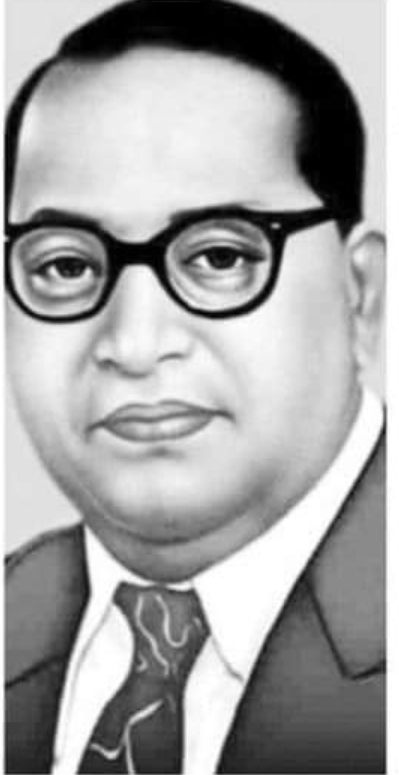
Ambedkar graduated from Elphinstone College, University of Bombay, and studied economics at Columbia University and the London School of Economics, receiving doctorates in 1927 and 1923 respectively and was among a handful of Indian students to have done so at either institution in the 1920s.[13] He also trained in the law at Gray’s Inn, London. In his early career, he was an economist, professor, and lawyer. His later life was marked by his political activities; he became involved in campaigning and negotiations for India’s independence, publishing journals, advocating political rights and social freedom for Dalits, and contributing significantly to the establishment of the state of India. In 1956, he converted to Buddhism, initiating mass conversions of Dalits.[14]
In 1990, the Bharat Ratna, India’s highest civilian award, was posthumously conferred on Ambedkar. The salutation Jai Bhim (lit. “Hail Bhim”) used by followers honours him. He is also referred to by the honorific Babasaheb (BAH-bə SAH-hayb).
Ambedkar was born on 14 April 1891 in the town and military cantonment of Mhow (now officially known as Dr Ambedkar Nagar) (now in Madhya Pradesh).[15] He was the 14th and last child of Ramji Maloji Sakpal, an army officer who held the rank of Subedar, and Bhimabai Sakpal, daughter of Laxman Murbadkar.[16] His family was of Marathi background from the town of Ambadawe (Mandangad taluka) in Ratnagiri district of modern-day Maharashtra. Ambedkar was born into a Mahar (dalit) caste, who were treated as untouchables and subjected to socio-economic discrimination.[17] Ambedkar’s ancestors had long worked for the army of the British East India Company, and his father served in the British Indian Army at the Mhow cantonment.[18] Although they attended school, Ambedkar and other untouchable children were segregated and given little attention or help by teachers. They were not allowed to sit inside the class. When they needed to drink water, someone from a higher caste had to pour that water from a height as they were not allowed to touch either the water or the vessel that contained it. This task was usually performed for the young Ambedkar by the school peon, and if the peon was not available then he had to go without water; he described the situation later in his writings as “No peon, No Water”.[19] He was required to sit on a gunny sack which he had to take home with him.[20]
Ramji Sakpal retired in 1894 and the family moved to Satara two years later. Shortly after their move, Ambedkar’s mother died. The children were cared for by their paternal aunt and lived in difficult circumstances. Three sons – Balaram, Anandrao and Bhimrao – and two daughters – Manjula and Tulasa – of the Ambedkars survived them. Of his brothers and sisters, only Ambedkar passed his examinations and went to high school. His original surname was Sakpal but his father registered his name as Ambadawekar in school, meaning he comes from his native village ‘Ambadawe‘ in Ratnagiri district.[21][22][23][24] His Marathi Brahmin teacher, Krishnaji Keshav Ambedkar, changed his surname from ‘Ambadawekar’ to his own surname ‘Ambedkar’ in school records.[25][26][27][28][29]
Education
Post-secondary education
In 1897, Ambedkar’s family moved to Mumbai where Ambedkar became the only untouchable enrolled at Elphinstone High School. In 1906, when he was about 15 years old, he married a nine-year-old girl, Ramabai. The match per the customs prevailing at that time was arranged by the couple’s parents.[30]
Studies at the University of Bombay

Ambedkar as a student
In 1907, he passed his matriculation examination and in the following year he entered Elphinstone College, which was affiliated to the University of Bombay, becoming, according to him, the first from his Mahar caste to do so. When he passed his English fourth standard examinations, the people of his community wanted to celebrate because they considered that he had reached “great heights” which he says was “hardly an occasion compared to the state of education in other communities”. A public ceremony was evoked, to celebrate his success, by the community, and it was at this occasion that he was presented with a biography of the Buddha by Dada Keluskar, the author and a family friend.[31]
By 1912, he obtained his degree in economics and political science from Bombay University, and prepared to take up employment with the Baroda state government. His wife had just moved his young family and started work when he had to quickly return to Mumbai to see his ailing father, who died on 2 February 1913.[32]
Studies at the London School of Economics

Ambedkar (In center line, first from right) with his professors and friends from the London School of Economics (1916–17)
In October 1916, he enrolled for the Bar course at Gray’s Inn, and at the same time enrolled at the London School of Economics where he started working on a doctoral thesis. In June 1917, he returned to India because his scholarship from Baroda ended. His book collection was dispatched on a different ship from the one he was on, and that ship was torpedoed and sunk by a German submarine.[32] He got permission to return to London to submit his thesis within four years. He returned at the first opportunity, and completed a master’s degree in 1921. His thesis was on “The problem of the rupee: Its origin and its solution”.[35] In 1923, he completed a D.Sc. in Economics which was awarded from University of London, and the same year he was called to the Bar by Gray’s Inn.[13]


Leave a comment